One Hour, One Room, One projector: The Families Who Refuse to Scroll
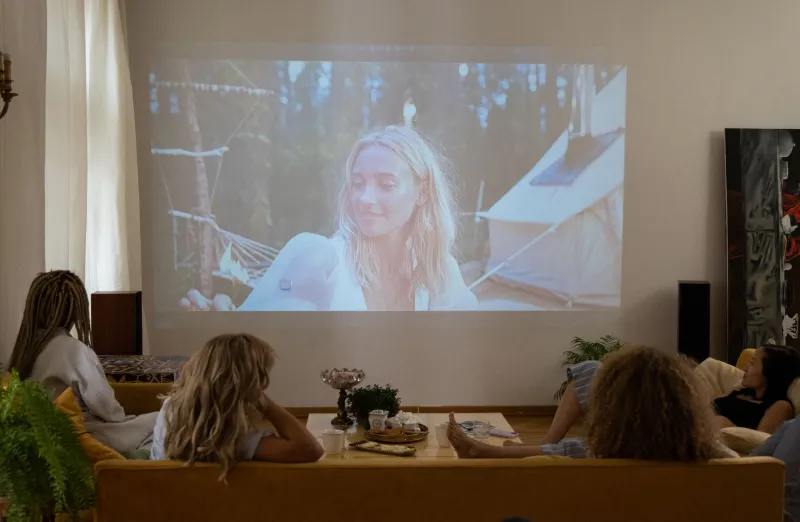
The Hendersons of Dayton, Ohio have a rule that sounds almost medieval in 2024: one night a month, every screen in the house goes dark except one. Not a TV. Not a tablet propped against a fruit bowl. A 1968 Kodak Carousel, inherited from a grandmother who labeled her slide trays in careful cursive, throwing forty-year-old summers onto a bedsheet pinned above the fireplace.
They're not alone. Scattered across the country — a family in Portland, a clan of cousins in suburban Atlanta, a retired teacher in upstate New York — a small but devoted group of Americans still runs the monthly family slideshow like it's a religious observance. And if you sit through one, you start to understand: this isn't nostalgia. It's architecture.
The Tyranny of the Infinite
We all carry roughly sixty thousand photos now, give or take. They live in a camera roll that has no floor and no ceiling, a bottomless drawer where a graduation sits two swipes from a grocery list. Nothing is lost, and because nothing is lost, nothing is chosen.
The slide-show families have made the opposite bet. A Carousel holds eighty slides. That's the whole deal — eighty frames, chosen in advance, arranged in an order someone thought hard about. When the tray is full, the story is over, and the lights come up.
"You can't binge it," says Megan Henderson, third-generation projector-keeper. "Dad curates the tray like he's editing a film. If a slide doesn't earn its spot, it doesn't go in. That was true in 1975 and it's true now."
That act of curation — deciding what deserves the wall — turns a pile of images into a narrative. Beginning, middle, punchline. The camera roll has none of that. It's a warehouse; the slide tray is a story.
The Ritual Is the Resolution
Here's what surprised me most talking to these families: nobody mentioned image quality. Not once. Nobody cared that the Kodachrome runs warm, or that slide #23 has a thumbprint on it from sometime during the Reagan administration.
What they talked about was the hour. Phones go in a basket by the door. The kids sprawl on the floor. Grandpa narrates, then contradicts himself, then gets corrected by Grandma, and that argument — the one about who was actually at Lake Michigan in 1987 — has become part of the family canon, retold monthly like a serialized drama.
Compare that to the modern alternative: the group text with forty-seven photos dumped at once, or the shared cloud album nobody opens. Digital sharing optimizes for delivery. It has no opinion about attention. The darkened living room, by contrast, is a machine for attention. One image at a time, everyone facing the same direction, nobody fast-forwarding.
"It's the only hour of the month where all five of us are looking at the same thing," one Portland dad told me. "Think about that. The same. Thing."
Passing Down the Machine
There's also a material inheritance at work here. These projectors are being handed down like pocket watches — cleaned, lubricated, occasionally repaired by the shrinking priesthood of analog AV technicians. The Henderson kids know the machine's moods: the whir of the fan, the soft mechanical clunk of the tray advancing, the way the bulb dims a beat before the slide changes, like the projector is gathering its thoughts.
You can't inherit a cloud account. You can inherit a machine with your grandmother's handwriting on the trays and her thumbprint on slide #23. The object carries the family in it.
Constraint as a Creative Act
It's tempting to file all this under "charming anachronism," but I think these families have stumbled onto something the rest of us keep failing to learn: the scroll was never the point. The pictures were. And pictures need a frame — temporal, physical, social — to become stories.
Eighty slides. One hour. One room. Once a month. The constraints aren't limitations on the experience. They're what make it an experience at all.
The lights dim. The fan hums. Somewhere in the tray, a beach in 1979 is waiting its turn.