Chemistry Class Never Ended: The Strip Mall Labs Refusing to Call It Quits
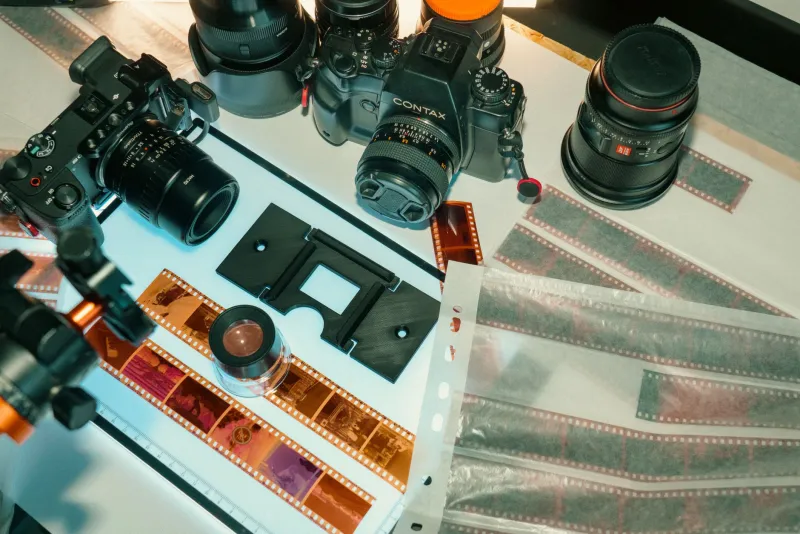
The sign out front still says One Hour Photo, which is a lie on two counts. It takes closer to three hours now, and there's a very real question of how many months are left before the whole operation shuts down for good.
Inside, past a wall of faded portrait samples and a bell that hasn't worked since 2019, Dennis Kwan is feeding a strip of 35mm film into a processor that's older than most of his customers. The machine clunks. It hisses. Somewhere in its belly, chemistry older than the internet is doing what it has done for sixty years: turning silver halide into memory.
"People assume we're nostalgic," Dennis says, eyes on the film as it snakes through the rollers. "I'm not nostalgic. I'm busy."
The Quiet Arithmetic of Disappearing
Here's the math nobody in the industry likes to say out loud. The chemicals that make color film development possible — the C-41 process, for those keeping score — come from a shrinking pool of suppliers. Shipping costs have climbed. Regulatory paperwork has multiplied. And the customer base, once every family in America, has narrowed to wedding photographers, art students, and a generation of twenty-somethings who discovered film on TikTok and never scrolled away.
Kodak's film sales have actually ticked upward in recent years, a genuine anomaly in an analog world. But film is only half the equation. The other half is the lab — the physical place with the ventilation, the plumbing, the trained hands. And labs don't sell in bulk. They close in ones.
According to industry estimates, the number of commercial film labs in the United States has collapsed from tens of thousands at the peak to a few hundred serious operations today. Many of those are mail-in services clustered in big cities. What's vanishing fastest is the neighborhood version: the lab in the strip mall next to the nail salon and the pho restaurant, the one where you could drop off a roll of your kid's birthday and pick up glossy prints before dinner.
What a Lab Knows That a Scanner Doesn't
Spend an afternoon at a working lab and you start to understand what's actually at stake. This isn't just about prints versus pixels. It's about judgment.
A good lab tech looks at your negatives and makes a hundred small decisions a machine never would. That underexposed shot from the graduation party? They'll push the exposure and rescue grandma's smile. That roll shot at a concert with weird stage lighting? They'll adjust the color balance by feel, the way a cook seasons by taste.
"The machine gives you average," says Rosa Delgado, who has run a lab in Albuquerque for twenty-two years. "I give you the picture you meant to take."
There's a practical layer, too. Lab techs are often the first people to spot a broken camera, a bad batch of film, mold creeping across a stored negative. They're diagnosticians, and like all diagnosticians, they're trained by volume — thousands of rolls, thousands of small corrections. That expertise doesn't transfer to a PDF manual.
The Unlikely Rescue Squad
The people fighting to keep these places alive are not who you'd expect. Sure, there are the film bros with their Leicas and their opinions about grain structure. But there are also retired schoolteachers volunteering at community darkrooms, municipal archivists who need drum scans of county records, and — most surprisingly — teenagers.
High school photo programs, once gutted when districts traded darkrooms for computer labs, are quietly coming back. In Ohio, a teacher named Marcus Webb rebuilt a darkroom from donated equipment and now has a waiting list for his elective. His students, he says, "have never known a photo they couldn't delete. When they watch an image come up in the developer tray, it's like magic they have to earn."
A loose network of enthusiasts has even started mapping surviving labs online — crowd-sourced directories that function like birdwatching logs for a species in decline. Some entries are annotated with notes that read like eulogies in advance: "Owner talking about retiring. Go now."
The Cost of the Last Print
It's worth asking the blunt question: does it matter? If film development becomes a mail-order service run out of three warehouses, who's harmed?
The honest answer is layered. Practically, communities lose a place where photographs — the physical evidence of lives — get made by a neighbor. Culturally, we lose one of the last businesses where the product is literally memory, handled by human hands with human care. And there's a subtler loss: the lab is one of the few remaining places where strangers talk to each other about something real. Dennis knows his customers' kids' names. He knows which wedding anniversaries matter. A drop-off window is a small thing, but small things are what neighborhoods are made of.
The economics aren't hopeless, exactly. Film prices have stabilized. Demand among young shooters keeps surprising everyone. Some labs have diversified — into scanning, into workshops, into printing for artists who want gallery-grade output. Survival, it turns out, looks less like a return to 1988 and more like a strange hybrid: analog chemistry in the back, digital services up front, and a community that finally understands what it almost lost.
Dennis pulls the finished prints from the processor and holds them up to the light. Two kids at a lake, sun flare across the water, imperfect and completely alive.
"People ask why I keep going," he says, sliding them into an envelope. "I tell them: everything on your phone can vanish with a password you forgot. This," he taps the print, "needs a fire to kill."
The bell above the door still doesn't ring. The customer walks in anyway. The machine, ancient and faithful, starts its warm-up hum for one more roll.