Carbon Arcs and True Grit: The Night Shift Keeping America's Analog Projectors Alive
The Smell of Ozone at Dusk
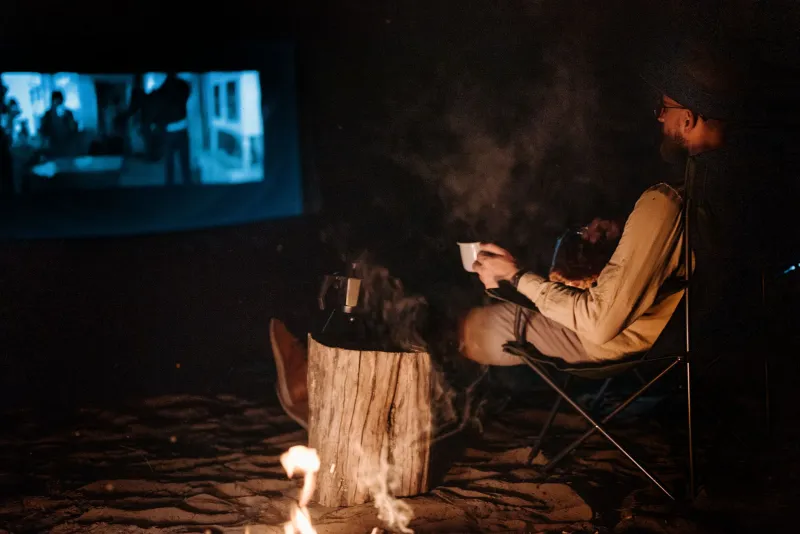
There's a moment, about twenty minutes before sunset, when the drive-in projectionist starts to feel it: the low hum of the lamphouse warming up, the faint metallic smell of ozone drifting off a carbon arc that hasn't changed its personality since the Eisenhower administration. Most audiences never notice any of it. That's the point.
But for the small fraternity of Americans who keep analog projection alive — in drive-ins, church lots, VFW halls, and the occasional backyard premiere — that smell is the whole job description.
"People think I'm nostalgic," says Dale, a retired electrician in rural Ohio who maintains three vintage projectors and lends them out for community screenings. "I'm not nostalgic. I just think a machine you can fix with your hands is worth more than a machine you have to mail away."
What It Actually Takes to Keep a 60-Year-Old Machine Running
The unglamorous truth: analog projection is less about romance and more about parts inventory. Carbon arc projectors, the pre-xenon dinosaurs that some purists still swear by, need their electrodes replaced, their motors greased, and their sprockets checked for wear the way a pilot checks a pre-flight checklist.
- Carbon rods — increasingly hard to source, sometimes machined by hobbyists when suppliers dry up
- Drive belts — often repurposed from sewing machines or lawnmower suppliers
- Condenser lenses — traded between collectors like baseball cards
- Sound heads — the magnetic variety died with the format wars; optical sound survives on stubbornness alone
Dale keeps a spreadsheet. It reads like a supply chain thriller: three rods left, one belt, a lens with a hairline crack he's chosen to ignore for two seasons now.
The Church Lot Circuit
Drive-ins get the press, but the quiet backbone of analog exhibition in America is the community screening. A Methodist church in Kansas projecting on a bedsheet strung between two basketball hoops. A volunteer fire department in Pennsylvania running a fall movie night off a 16mm projector older than most of the volunteers.
These aren't film buffs, mostly. They're people who inherited a projector from a grandfather, or bought one at an estate sale for forty dollars, and discovered that a whirring reel and a flickering beam make a parking lot feel like a place.
There's a texture to it that a laptop and a rented LED panel can't fake. The beam is visible in the dust. The film pops. Somebody's kid walks through the picture and every adult remembers doing the exact same thing at their own childhood screening.
Why Not Just Go Digital?
The practical answer: a digital cinema package server costs more than most community organizations can justify, and licensing gets complicated fast. The philosophical answer is messier.
"Digital is perfect," Dale says, and he doesn't mean it as a compliment. "Perfect doesn't break down in a way you can fix. Perfect doesn't have a personality. When my projector hiccups, the whole lot laughs, and then it comes back, and everybody cheers. You can't cheer for a hard drive."
There's also the matter of stewardship. Every projectionist interviewed for this piece described themselves less as an owner and more as a temporary custodian. Machines that outlived their manufacturers, their original theaters, and in some cases their original owners, now pass hand to hand at estate sales and collector swaps like living things.
The Stubbornness Problem — and Why It Might Be the Point
It would be easy to frame all this as pure resistance to change, and some of it is. But talk to these folks long enough and a different theme emerges: they're not against digital. They're against the idea that watching something together should be frictionless.
Analog projection requires a person to be present. Someone has to thread the film, watch the reels, make the changeover on cue. The machine demands a human, and that human becomes the reason forty neighbors showed up in folding chairs on a Tuesday.
Maybe that's what the stubbornness is really about. Not the format. The excuse. An old projector gives a town a reason to gather, and a person gives the machine a reason to run. Take either one out of the loop and you've got a perfectly good movie playing to an empty lot.
The Next Generation of Wranglers
Here's the hopeful twist: it's not dying out. Film schools are teaching 16mm again. Young projectionists are showing up at collector meetups with soldering irons and YouTube tutorials. The machines, built in an era when things were meant to be repaired, are forgiving teachers.
Dale has started letting a teenager from down the road shadow him at screenings. "Kid's got better hands than I do," he admits. "He'll get the lenses I've been hoarding. Somebody should."
Somewhere tonight, a carbon arc will stutter to life over a cornfield or a church lawn. The picture will flicker, the sound will hiss, and a crowd that came for a movie will get something slightly better: proof that somebody cared enough to keep the light on.