Error 404: Perfection Not Found — And That's Exactly the Point
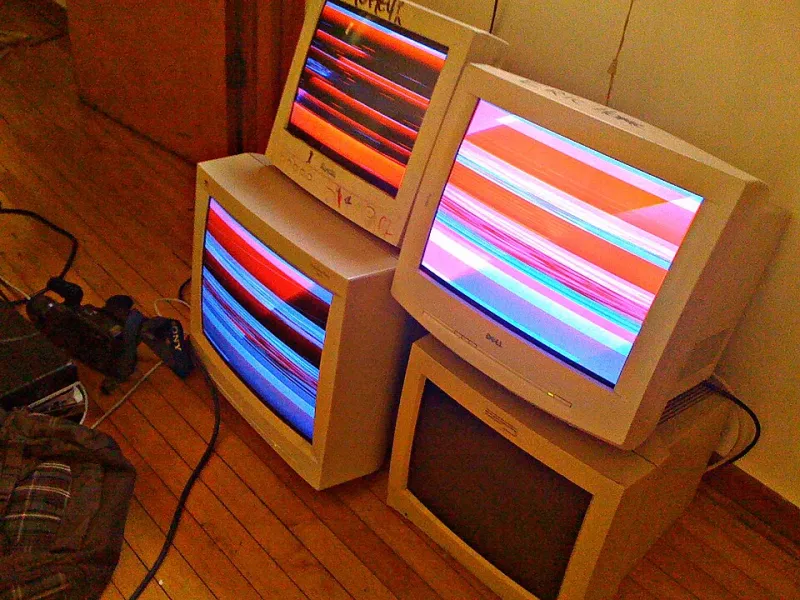
Photo: jonCates, CC BY-SA 4.0, via Wikimedia Commons
There's a moment most of us recognize — that split second when a video freezes mid-frame, tiles into a mosaic of blocky color, and your brain scrambles to decode what it's seeing. Usually, you hit refresh and move on. But a growing community of artists and designers isn't moving on. They're hitting pause right there, zooming in, and calling it finished.
Welcome to the world of intentional glitch art, where broken is beautiful, corrupted is considered, and the error message is the whole message.
When the Machine Starts Talking Back
Glitch aesthetics have been floating around the fringes of digital art since at least the early 2000s, but something has shifted in the last few years. What was once a niche underground movement — think experimental video artists playing with VHS signal noise and early internet databending — has migrated into mainstream design, music video direction, fashion photography, and even brand identity work.
The timing isn't accidental. We live inside a visual culture that has been aggressively, almost pathologically, optimized. Instagram filters smooth every pore. AI upscaling sharpens every edge. Generative tools can produce images so technically flawless they look like they were rendered by a god with a 4K monitor. And somewhere in all that perfection, a lot of artists started feeling like something was missing.
That something, it turns out, was friction.
"Clean is a lie we've all agreed to tell each other," says Brooklyn-based digital artist Maya Osei, whose recent series Signal Loss features portraits deliberately run through compression algorithms until faces partially dissolve into abstract geometry. "I want people to feel the instability in the image. Because that instability is real. That's what it actually feels like to exist right now."
The Philosophy Behind the Pixel Chaos
To understand why glitch art resonates so deeply, it helps to think about what a glitch actually is. At its core, a glitch is a failure — a moment when a system can't do what it was designed to do. Data gets dropped, color channels separate, timing falls apart. The image doesn't lie to you. It just breaks.
And there's something philosophically loaded about that.
In an era when we're all acutely aware that images can be manipulated, deepfaked, and algorithmically generated to tell any story someone wants to sell, a genuinely broken image carries a weird kind of credibility. It wasn't made to flatter anyone. It wasn't optimized for engagement. It just fell apart — and in falling apart, it revealed something the polished version was covering up.
Los Angeles-based photographer and designer Tomás Riera has been deliberately corrupting his landscape photography for the past three years, using a process he describes as "controlled destruction." He opens image files in text editors, manually edits the raw data, then re-saves them to see what comes out. The results look like satellite imagery from a planet that doesn't quite exist — familiar landscapes fractured into cascading color blocks and smeared horizons.
"The original photo is fine. It's technically correct," Riera explains. "But the corrupted version tells you how I actually felt standing in that place. Overwhelmed. Fragmented. Like I couldn't quite hold the whole thing together in my head."
Weaponizing Imperfection
What separates intentional glitch art from, say, just dropping your phone in a puddle is the level of craft involved. The artists doing this work aren't randomly smashing files and calling it a day. They're developing deep technical knowledge of how digital images are structured — understanding codecs, compression algorithms, color depth, and file formats well enough to break them in precise, repeatable, meaningful ways.
Some use databending, the practice of opening image or video files in software never designed to read them — audio editors, text processors, hex editors — and introducing controlled mutations. Others write custom code that introduces specific types of noise or artifact. Still others work with physical methods: scanning damaged prints, photographing screens through interference, or deliberately degrading analog-to-digital transfers.
The results range from subtly unsettling to full sensory assault, but the best work lands somewhere unexpected — it feels both wrong and completely right at the same time.
Chicago-based motion designer Kira Sands uses glitch techniques in her commercial work, a fact that surprises some of her clients at first. "They come in wanting something slick, and I'll show them a treatment that has these deliberate artifacts, these little moments where the image seems to hesitate," she says. "And once they see it, they usually get it immediately. It feels more real. It feels like it was made by a human."
That last line is worth sitting with for a second.
The Human Fingerprint in the Broken Frame
There's a reason glitch aesthetics feel increasingly relevant right now, and it has everything to do with AI. As machine-generated imagery floods every corner of the internet — flawless, consistent, and utterly uncanny — imperfection has become one of the few reliable signals of human authorship.
A glitch can't really be faked by a system optimized for coherence. It requires understanding failure well enough to replicate it, which, paradoxically, takes a lot of skill. The corruption has to be specific enough to feel intentional rather than accidental, controlled enough to serve the composition, and honest enough to carry emotional weight.
In other words, it has to be made by someone who cares about what they're breaking.
That care is exactly what shows up in the best glitch work — and it's what separates it from visual noise. When Maya Osei corrupts a portrait until a face becomes half-abstract, she's not being lazy or provocative for its own sake. She's making a precise argument about identity, visibility, and the way digital systems flatten the complexity of human beings into data points.
The glitch is where that argument lives.
What Comes Next
As the aesthetic continues to move into the mainstream — you can already spot glitch-influenced design in everything from album artwork to sneaker campaigns to UI design — there's a natural question about whether it loses its edge. Does intentional imperfection become just another style to be packaged and sold?
Maybe. But the artists working at the forefront of this space seem less concerned with staying underground than with staying honest. The tools and the techniques will evolve. What won't change is the underlying impulse: the refusal to pretend that everything is fine, clean, and perfectly rendered.
Sometimes the most truthful thing a frame can do is fall apart.
And sometimes, staring at the wreckage, you see something you never would have found in the pristine version.