Your Eyes Are Being Lied To — And You're Loving Every Second of It
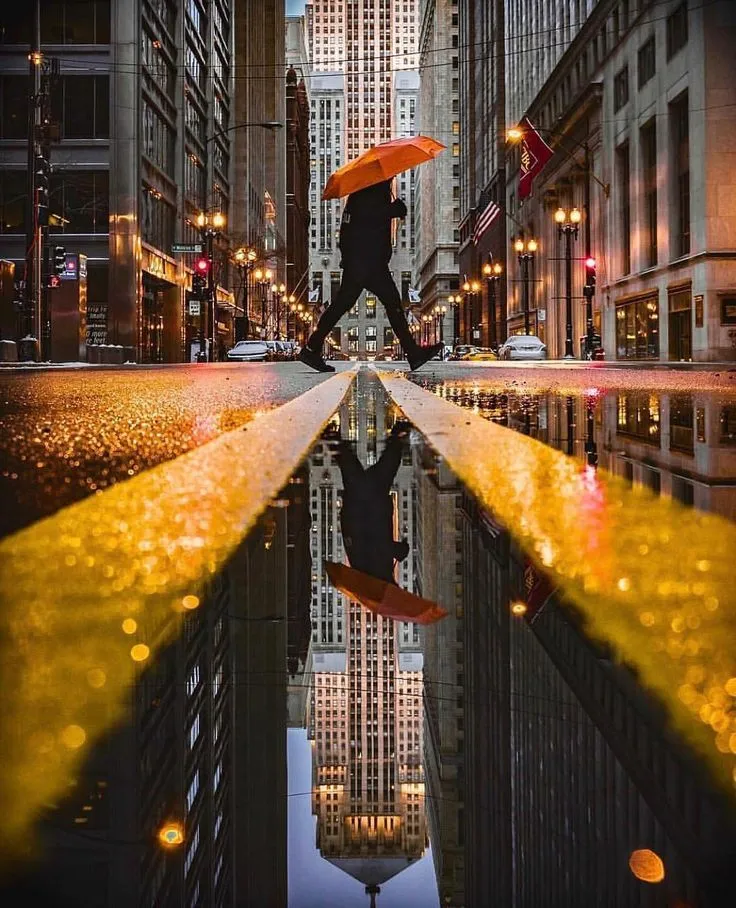
Photo: dramatic leading lines photography urban street perspective depth, via i.pinimg.com
There's a photograph hanging in a coffee shop near my apartment. It's a long-exposure shot of a city street — cars blurred into ribbons of gold and red light, a pedestrian frozen mid-stride, buildings stacked into the sky. Every time I sit down with my drink, I find myself moving through that image. My gaze starts at the bottom left, rides the curve of the road upward, drifts past the pedestrian, and lands somewhere near the top of the frame where the lights dissolve into dark sky.
The photo is completely still. And yet it never feels that way.
That's not an accident. That's composition doing exactly what it was designed to do.
The Brain Wants a Story, Not a Snapshot
Here's something that doesn't get talked about enough: when you look at a photograph, your brain isn't passively receiving an image. It's actively constructing a narrative. Neuroscientists call this predictive processing — your brain is constantly filling in gaps, anticipating patterns, and projecting meaning onto visual information.
Photographers and visual designers have been exploiting this tendency for well over a century, often intuitively, sometimes methodically. The result is a toolkit of compositional techniques that don't just make images look good — they make images feel kinetic. Dynamic. Alive.
Understanding that toolkit changes how you see everything.
Leading Lines: The Highway Your Eye Can't Resist
Few tools in photography are as blunt or as effective as the leading line. A road vanishing into the horizon. A staircase spiraling upward. A river cutting diagonally across a landscape. These aren't just pretty visual elements — they're directional commands your brain can't ignore.
When a strong diagonal or converging line enters your field of vision, your visual cortex interprets it as a vector — something with direction and implied destination. Your eye follows it. You experience the sensation of traveling, even though you're standing completely still in front of a screen or print.
The most powerful leading lines don't just point somewhere. They point somewhere interesting. They deliver your attention to a subject, a light source, or a point of tension in the frame. The journey becomes the meaning.
Ansel Adams understood this intuitively. His landscapes aren't just technically pristine — they're architecturally designed to move you through them. The road in The Tetons and the Snake River doesn't just meander; it pulls.
Layering: Depth That Makes You Lean In
Flat images feel inert. Images with depth feel like portals.
Layering — the deliberate placement of visual elements across foreground, midground, and background — creates what psychologists call pictorial depth cues. Your brain, wired by evolution to navigate three-dimensional space, interprets these overlapping planes as real distance. You don't just look at a layered image; you look into it.
Street photographers are masters of this. A sharp face in the foreground, a blurred crowd behind, a slice of architecture even further back — each layer adds a new dimension, and your eye bounces between them, constructing a sense of space that extends well beyond the flat surface of the print.
Bokeh, that buttery background blur that Instagram made famous, works on this same principle. It's not just aesthetically pleasing — it's a depth signal. It tells your brain that space exists behind the subject, and suddenly the image has volume.
The Diagonal Rule: Why Stability Is the Enemy of Energy
Here's a counterintuitive truth: perfectly balanced, symmetrical compositions can feel lifeless. When everything is centered and level, the image reaches a kind of visual equilibrium — and equilibrium doesn't move.
Diagonals disrupt that equilibrium in the best possible way. A tilted horizon. A subject positioned at an angle. A shadow cutting across the frame at forty-five degrees. These elements introduce visual tension, and tension implies force, and force implies motion.
Think about action photography — even in a frozen frame, the most dynamic shots almost always feature strong diagonal lines. A basketball player mid-jump, their body angled against the court. A surfer cutting across a wave at a sharp vector. The diagonal is the movement, even when nothing is actually moving.
This is why the rule of thirds, for all its usefulness, can sometimes be a ceiling rather than a floor. Placing your subject slightly off-center creates implied movement toward or away from the negative space. The subject isn't just in the frame — they're going somewhere.
Negative Space as a Tension Machine
Speak of negative space, and most people think of minimalism — clean, quiet, meditative images. And sure, empty space can do that. But negative space is also one of the most underrated tools for creating psychological momentum.
When a subject faces into open space, your brain anticipates movement into that space. When a figure stands at the edge of a vast landscape, you feel the pull of the world beyond the frame. The emptiness isn't absence — it's potential. It's the held breath before something happens.
Wildlife photographers use this constantly. A bird photographed with the open sky in front of it feels like it's about to take flight, even if it's perfectly still. Flip the composition — put the bird at the leading edge of the frame with nothing behind it — and suddenly the image feels arrested, static, trapped.
Same bird. Completely different feeling. That's the power of where you put the empty.
Putting It All Together
The best visual storytellers don't use these techniques in isolation — they layer them, combine them, let them reinforce each other. A strong diagonal leading line that moves through multiple depth layers toward a subject sitting in meaningful negative space? That's not just a good photograph. That's a full sensory experience disguised as a still image.
Volante Eyes exists because we believe every frame tells a story. And the most captivating stories aren't the ones that show you everything — they're the ones that move you through a world, guide your gaze with purpose, and make you feel like you witnessed something even though you were standing perfectly still.
Your eyes are being lied to. And honestly? That's exactly the point.